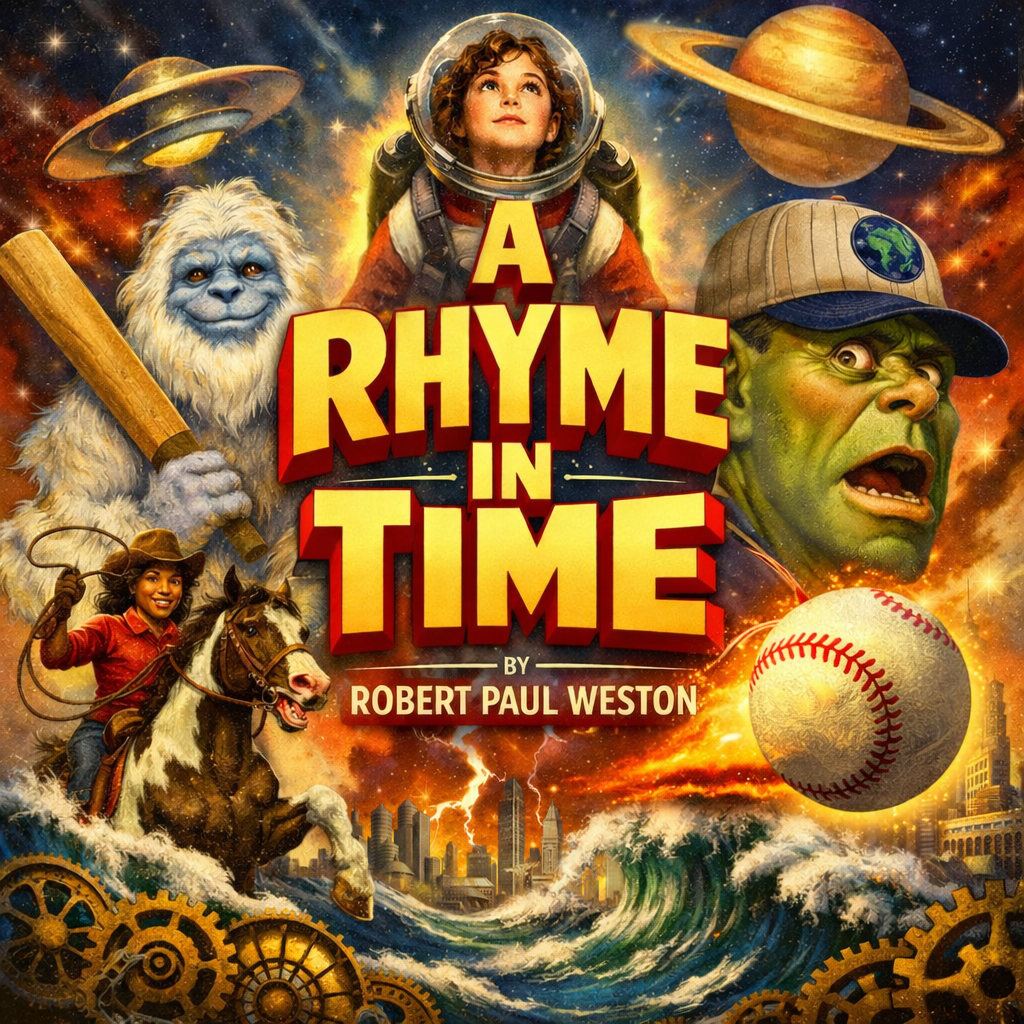
As mentioned elsewhere, A Rhyme in Time was my “lockdown novel“.
Unfortunately, the economic pressures of the pandemic also saw Zorgamazoo‘s publisher, Razorbill Books, cease operations, merging with Putnam. This left me with a sequel manuscript but no publisher. It was a dispiriting situation, but I took heart in the underlying ideas and research that originally inspired Zorgamazoo. Those ideas led me to a decision to turn the book into a podcast – an acoustic novel in a purely acoustic form – and that’s what this post is about.
Back in the early 2000s, my initial inspiration to write a novel-in-verse was partly inspired by a series of linguistics experiments conducted by Virginia Mann at Haskins Laboratories in 1984, as well as the work of Reuven Tsur, a pioneer in the field of cogntive poetics, the study of what happens in your brain while reading, writing, or listening to poetry.
Mann’s work focused on young readers, notably those with poor reading skills, what today we might call “reluctant readers.” She found they had better recall when asked to remember lists of rhyming words, indicating they may use rhyme as a mnemonic device, doing so more readily than their peers.
Tsur’s research revealed broader, more general insights about poetry and how we consume it. He found rhyme and rhythm, separately and in concert, heightens our emotional response to verse, and might account for the vivid, dream-like, almost out-of-body experiences reported by those most profoundly affected by poetry, experiences resembling Samuel Taylor Colleridge’s well-known composition of ‘Kubla Khan’.
Which brings me to empathy, the ability to understand how others think and feel, particularly those unlike ourselves.
People and societies exhibiting high levels of empathy are more harmonious, more generous, and happier. Unfortunately, empathy is on the decline. A thirty-year study of American university students found empathy had declined 48% between 1979 to 2009, with the most dramatic fall in the study’s final nine years, 2000 to 2009, indicating a recent and worrying acceleration.
One way to help reverse this trend is by reading fiction, which correlates strongly with empathy, especially if you read novels as a habit, over a lifetime. This habit, of course, begins in childhood. Yet over the past twenty years, reading for pleasure has also declined, thus adding credence to its link to empathy. Put another way, as the reading of fiction declines, so does kindness, generosity, altruism, happiness.
Originally, Zorgamazoo was intended to counter this. Drawing in part on the research mentioned above, it was meant to be a book for the unbookish – a book for young people who didn’t like them.
But rhyme isn’t merely an important scaffold for the reluctant reader. There’s also evidence that, for all young readers, rhyming poetry improves reading ability and language frequency more than repeated reading of prosaic, non-rhyming text, and awareness of rhyme plays a unique and distinctive role in reading development, even after controling for differences in linguistic skills, intelligence, and social background.
Beyond the rhyme, there’s also strong evidence that shared reading experiences uniquely improves literacy and strengthens bonds between children and caregivers, benefits that apply even in older children. By explicitly writing a “read-aloud” novel, my goal is a book that inherently encourages this relationship-building and linguistic development.
Unfortunately, there’s an arguement to be made we are all, slowly, inexorably, becoming reluctant readers of fiction and, for the reasons I’ve already listed, it’s not a good look.
With this in mind, I hope my rhyming novels – Zorgamazoo, Prince Puggly of Spud and the Kingdom of Spiff, and now, A Rhyme in Time – will in some way encourage literacy. It’s my small effort, as a writer, to nudge readers towards the lifelong habit of reading. The benefits, as I hope I’ve demonstrated, are too valuable to ignore.
So—
I’m putting out A Rhyme in Time as a podcast novel, free to listen to by anyone, anywhere, anytime.
I intend this project to be slightly distinct from an audiobook, which strives for a dramatic reading of prose on a page. Instead, I might call A Rhyme in Time an “acoustic novel”, not merely fiction read aloud, but rather a story whose form inherently flows into this medium.
Over the next few months, I aim to release a new chapter each week. If there’s a child somewhere in your life, especially a reluctant reader, I hope you’ll point them in the story’s direction. I hope you’ll listen along as well. And I hope you enjoy the continuing adventures of Katrina and Morty, and all their friends.
Finally, most importantly, I hope at least some of those who listen grow up to be lifelong readers of fiction.
We need as many as we can get.
🚀🚀🚀
Sample the preface to A Rhyme in Time here:
Listen or subscribe on Apple Podcasts and Spotify: